
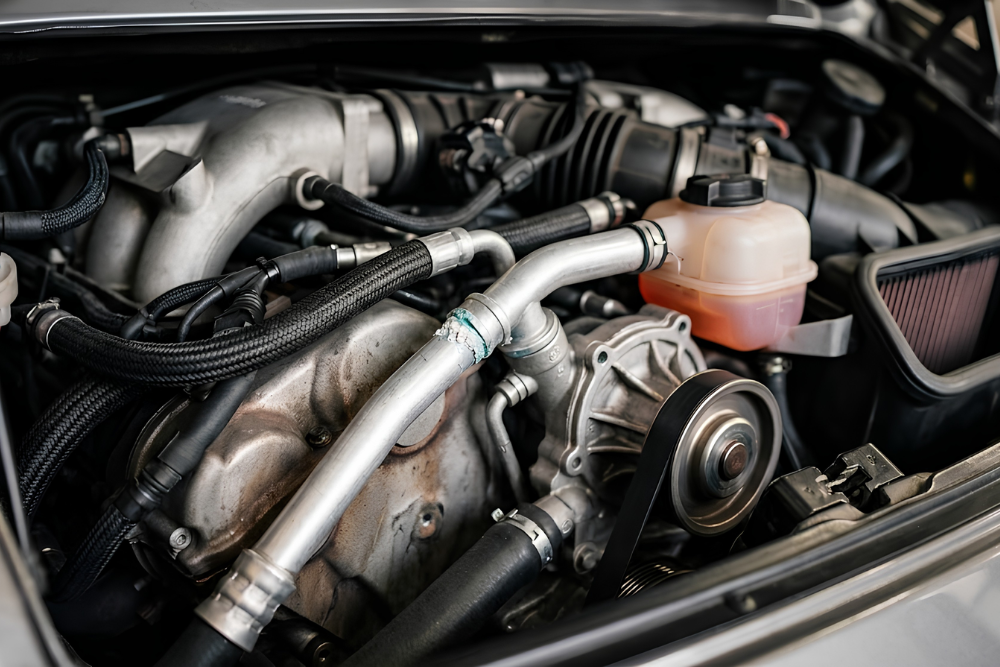
Porsche cooling system repair is something every Cayman, 911, Cayenne, and Panamera owner will eventually face. These are precision-engineered vehicles, but their cooling systems have well-documented weak points that tend to show up with age and mileage. At MB Automotive Services, we specialize exclusively in German and British European vehicles, and we see Porsche cooling failures regularly in our North Bethesda shop. Knowing the warning signs early and understanding the specific issues tied to your model can save you from a very expensive engine repair down the road.
The cooling system in these cars is responsible for keeping the engine at the right operating temperature. When it fails, the consequences aren’t minor. Coolant pipe failures, water pump breakdowns, and slow leaks can quietly push your engine toward overheating before you ever see a warning light. This guide walks you through the most common Porsche cooling system issues by model, how to spot them, and why staying ahead of them is the smartest move you can make as a Porsche owner.
The Glued Coolant Pipe Problem: A Known Porsche Engineering Issue
One of the more serious and less talked about cooling failures we see involves a factory design decision: Porsche used epoxy adhesive to bond slip-fit metal and metal coolant pipes directly into the engine block on certain models. Over repeated heating and cooling cycles, that adhesive degrades. The result is pipes that suddenly detach and dump coolant without warning.
This isn’t a freak accident. It’s a documented pattern that affects specific generations.
911 GT3, GT2, and Turbo (Mezger Engine, 996 and 997 Generations)
On Porsche’s Mezger-engine models, including the 996 (1999 to 2004) and 997.1/997.2 (2005 to 2013) GT3, GT2, and Turbo, there are roughly 8 to 12 slip-fit coolant fittings on the engine block that were originally secured with adhesive. When that glue lets go, coolant escapes fast.
Because the engine has to come out to access these fittings properly, the standard repair is either welding the pipes in place with billet-aluminum replacements or having the fittings drilled and pinned, a process that physically locks each fitting so it can’t back out. Both repairs are labor-intensive, but they address the root cause rather than patch it.
If you own a 996 or 997 Turbo, GT3, or GT2 and haven’t had this inspected, it’s worth knowing where you stand before it fails on you.
Cayenne V8 and Panamera Adhesive Coolant Pipe Failures
The same adhesive failure pattern shows up in V8-powered models:
- Early V8 Cayenne (955/957, 2003 to 2010): Plastic coolant pipes tucked beneath the intake manifold were prone to cracking and failure. Many owners replace these with aftermarket aluminum pipes.
- Later Cayenne 958 (2011 to 2018) and Panamera (2010 to 2016): These models used slip-fit metal pipes with the same degrading adhesive as the Mezger engines. The fix is typically replacing the factory pipes with updated one-piece metal or aluminum alternatives.
The Cayenne and Panamera were the subject of a class action lawsuit over this specific defect. It’s a real issue, not a rumor.
Model-Specific Coolant Leak Points You Need to Know
Beyond the adhesive pipe issue, Porsche’s various platforms each have their own weak spots. Here’s what we see most often by model.
Porsche Macan and Cayenne V6 Engines and the Y-Pipe
On V6-powered Macan and Cayenne models, one of the most common failure points is a plastic coolant vent line that runs from cylinder head to cylinder head beneath the intake manifold. It’s often called the Y-pipe. Engine heat makes the plastic brittle over time, and when it finally cracks or snaps, the coolant loss can be sudden and severe. Many owners find themselves stranded with no warning.
Porsche 911, Boxster, and Cayman (996, 997, 991, 987, 981, 718)
These generations share a few recurring issues:
- Water pump failure: The water pump is a frequent failure point across multiple generations. Internal bearings wear out, causing leaks and in worse cases the impeller grinding into the engine block. By the time you hear a noise, significant damage may already be in progress.
- Plastic hose nipples: On 996-generation cars especially, the plastic nipples on the front radiators degrade and can snap off, causing sudden coolant loss.
- Adhesive coolant lines: On 997 models, factory adhesive holds the metal coolant lines in place. When that adhesive fails, the lines slip out.
Porsche Panamera Coolant Routing Through the Dust Cowl
On the Panamera, Porsche routed coolant and heater lines through the plastic dust cowl near the windshield wipers. When that cowl deteriorates, it can leak coolant into areas of the car it has no business being in. It’s an easy one to miss if you don’t know to look for it.
The Lifetime Coolant Myth and Why It Matters
Porsche officially classifies its factory coolant as a “lifetime fluid” with no mandatory change interval in the standard maintenance schedule. This is a position we respectfully disagree with.
Coolant doesn’t last forever. Over time, it becomes acidic. Acidic coolant attacks metal and rubber components from the inside out, accelerating corrosion in the water pump, pipes, hoses, and engine block passages. It also breaks down the protective additives that prevent scale buildup and electrolytic corrosion.
The independent mechanic community and Porsche enthusiasts have largely settled on a practical recommendation: change the coolant every 4 to 6 years or every 40,000 to 60,000 miles, whichever comes first. Many owners also choose to do a coolant flush whenever the water pump is serviced, which typically falls between 60,000 and 80,000 miles. That’s a logical combination service.
If your Porsche has never had the coolant changed and it’s more than a few years old, this is worth addressing. Schedule a cooling system inspection with MB Automotive Services online at mbautoinc.com or call us at 301-881-8990.
Overheating Risks and What Happens When You Ignore Them
Overheating is one of the most destructive things that can happen to a Porsche engine. Even a single episode can warp cylinder heads, damage head gaskets, and score cylinder walls.
What makes it particularly dangerous in modern Porsches is that the engine management system can temporarily mask early temperature spikes. Cooling fans may compensate, or the ECU may reduce power output to protect the engine. By the time the warning light stays on, significant damage may already be in progress.
Catching these problems early, whether it’s a slow adhesive pipe failure, a weeping water pump, or acidic coolant eating away at components, is how you avoid a repair bill that’s an order of magnitude larger than the inspection would have cost.
Preventative Porsche Cooling System Care in North Bethesda
When you bring your Porsche to MB Automotive Services, a thorough cooling system service covers what actually matters for these vehicles:
- Coolant condition check: Testing pH and freeze protection to determine if the coolant has degraded beyond safe use
- Pressure test: Pressurizing the system to identify leaks that aren’t yet visible, including early-stage adhesive pipe failures
- Hose and pipe inspection: Visual and tactile inspection of all rubber hoses, plastic pipes, and coolant fittings for cracking, swelling, or movement
- Water pump inspection: Checking for bearing play, leaks from the weep hole, and any signs of impeller damage
- Thermostat function: Confirming the thermostat opens and closes at the correct temperature
- Coolant flush: Removing old coolant and refilling with the correct Porsche-approved specification fluid
Not all coolants are the same, and mixing incompatible fluids can accelerate the very corrosion you’re trying to prevent. We use the right spec fluid for your specific model.
Why Porsche Owners in North Bethesda Trust MB Automotive Services
When it comes to your Porsche, you need a shop that knows these vehicles, not one that sees them occasionally. Here’s why Cayman, 911, Cayenne, and Panamera owners from North Bethesda, Bethesda, Chevy Chase, and Potomac bring their cars to us:
- German and British vehicle specialists: We work exclusively on European makes, so Porsche cooling system repair is part of our regular workflow, not a one-off job.
- Factory-level diagnostic tools: We use Autel, ISCAN, Autologic, and factory diagnostic equipment to accurately pinpoint cooling system faults, from pressure irregularities to water pump failure, so nothing gets missed.
- 24-Month/24,000-Mile Warranty: Our repairs are backed by a solid warranty, giving you real confidence after every service.
- Loaner vehicles available: Five VW Jetta loaners are on hand so your day doesn’t stop while your Porsche is in the shop.
- Metro shuttle service: If you’d rather not wait, we’ll get you where you need to go.
- Transparent communication: We show you exactly what we found, walk you through the repair, and return your old parts so you can see what was replaced.
- Owner accessibility: When you call, you speak directly to the owner, not a phone tree.
- Bosch financing available: Need to spread out the cost of a repair? We offer financing through Bosch.
FAQs About Porsche Cooling System Repair
What are common Porsche cooling issues?
Common Porsche cooling issues include adhesive coolant pipe failures, cracked plastic Y-pipes, failing water pumps, and degraded hose fittings. The specific failure point varies by model and generation, making accurate diagnosis by a European specialist important.
Why is my Porsche leaking coolant?
Coolant leaks in a Porsche are most often caused by degraded adhesive on slip-fit coolant fittings, cracked plastic pipes, a failing water pump seal, or deteriorated hose connections. Heat cycles and age break down these components, and even small leaks can escalate quickly if left alone.
How much is a Porsche water pump replacement?
Porsche water pump replacement costs vary depending on the model, year, and whether additional components like hoses or the thermostat are replaced at the same time. Contact a qualified European vehicle specialist for an accurate estimate specific to your vehicle.
How do I know if my Porsche thermostat is bad?
A failing Porsche thermostat typically causes the engine to run hotter than normal, take longer to reach operating temperature, or show inconsistent temperature gauge readings. If your gauge is behaving erratically, have a European specialist inspect the thermostat before it leads to overheating.
Schedule Your Porsche Cooling System Repair in North Bethesda Today
Keeping your Porsche running right starts with staying on top of cooling system maintenance. Whether you’re dealing with a suspected adhesive pipe issue, a water pump warning sign, an overdue coolant flush, or just want a thorough inspection, our team is ready to help.
Looking for Porsche cooling system repair near you? Visit us at MB Automotive Services, 11874 Coakley Cir., North Bethesda, MD 20852, or call 301-881-8990. Schedule online at mbautoinc.com. We serve North Bethesda, Bethesda, Chevy Chase, Potomac, Rockville, Gaithersburg, and Darnestown. Don’t let a small leak turn into a major repair.